
Power Requirement
The maximum load or generation the battery must support at any moment sets the required MW rating.
BESS Sizing & Design
Battery size should be driven by the project's objective, not simply by selecting a standard MW/MWh configuration.
Sizing a battery energy storage system means matching power, energy and operating strategy to what the project is actually trying to achieve. Two projects with the same MW/MWh rating can perform very differently depending on how they are used.
In practice, sizing starts with the objective: peak shaving, solar self-consumption, grid services, arbitrage or a combination. From there, the load and generation profiles, grid connection and commercial strategy narrow down which configurations can work. The result is rarely a single obvious answer, but usually a small set of configurations that can be compared and refined.
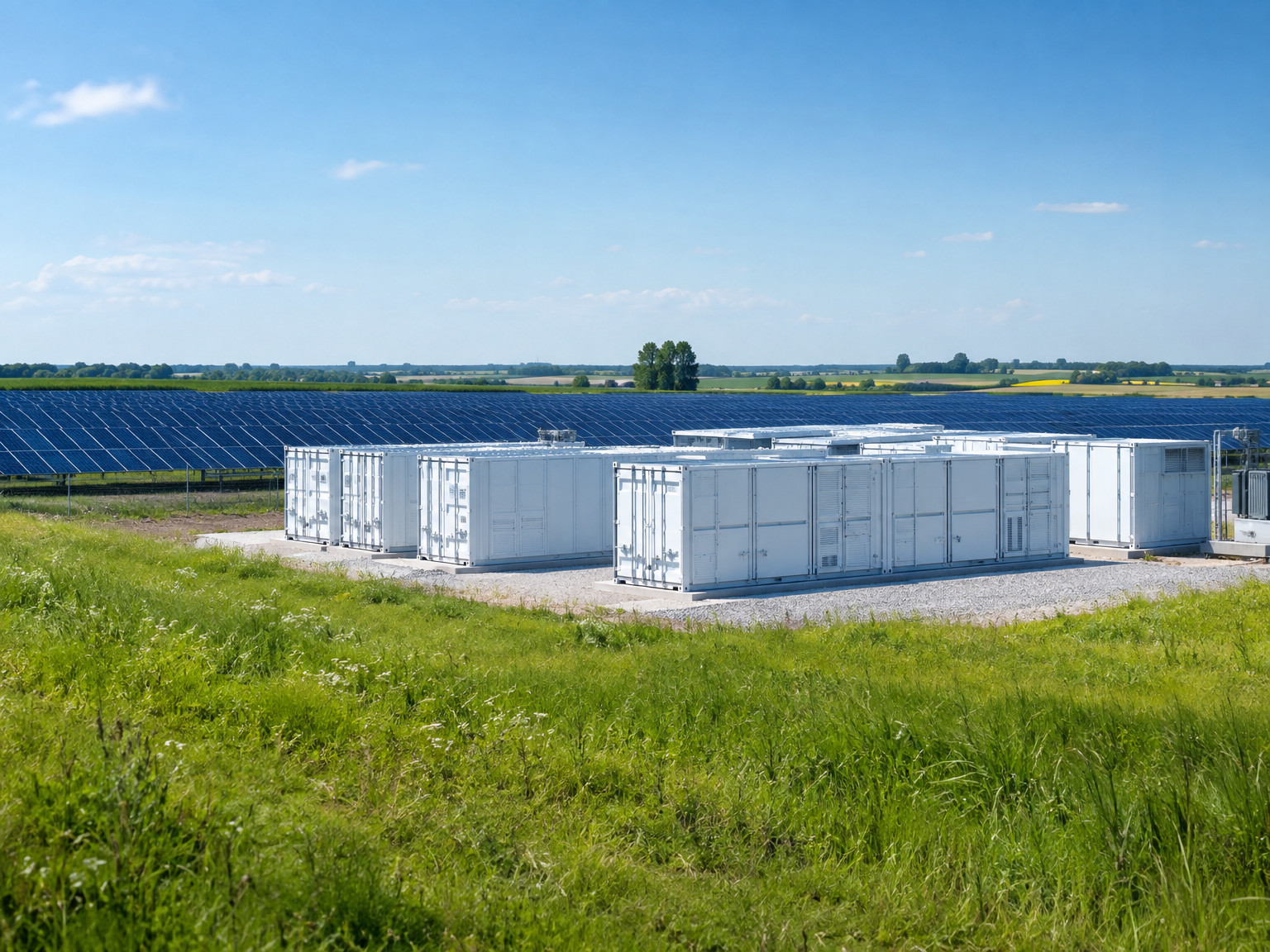
Determining Factors
The maximum load or generation the battery must support at any moment sets the required MW rating.
How much energy must be shifted or delivered per cycle determines the required MWh capacity.
The number of hours the battery should operate at full power follows from the application and its duty profile.
The ratio of power to energy affects cell selection, thermal design and how hard the system is driven.
The shape and timing of consumption, not just its size, influences which operating strategy is realistic.
For co-located solar, production hours and seasonal variation affect how often and how deeply the battery cycles.
Available connection capacity can constrain power rating regardless of what the application itself requires.
Expected cycles per day and per year drive degradation and therefore the usable life of the system.
Which services the battery is intended to provide shapes both its size and how it should be operated.
Capacity fades over time, so the battery may need headroom to still meet requirements later in its life.
Losses between charging and discharging reduce usable energy and affect the economics of every cycle.
If growth is expected, layout, inverters and grid connection can be planned to allow later extensions.
Fundamentals
Sizing a battery energy storage system means matching power, energy and operating strategy to what the project is actually trying to achieve. Two projects with the same MW/MWh rating can perform very differently depending on how they are used.
MW= Power
How much electricity the battery can deliver or absorb at any moment.
Full output, moment by moment
MWh= Energy
How much electricity the battery can store and deliver over time.
Stored energy, released hour by hour
Example: A 2 MW / 4 MWh battery can run at full power for two hours, depending on operating conditions such as temperature, state of charge and degradation. The same system could instead deliver 1 MW for around four hours, or 4 MW for roughly half an hour.
Engineering Trade-offs
The main sizing parameters interact. A longer duration usually means a lower C-rate and a larger investment; more frequent cycling increases revenue potential but also accelerates degradation; and every round trip loses a share of the energy to round-trip efficiency. Changing one parameter can therefore shift the economics of the others.
For this reason, battery sizing is an iterative engineering task rather than a lookup table. Configurations are modelled against the actual load and generation data, compared on lifecycle cost and performance, and refined until a defensible choice emerges. The outcome depends on project conditions, and the assumptions behind it should always be stated explicitly.
We can help you work from your objective and data towards a configuration that is technically and commercially defensible.